

A Russian-installed occupation official in southern Ukraine has said Moscow was likely to pull its troops from the west bank of the Dnipro River, signalling a huge retreat that, if confirmed, would be a major turning point in the war.
Still, Ukrainian officials and Western analysts remained cautious about signs that Russia was abandoning the area, and there was silence from higher-ups in Moscow over what would amount to one of Russia’s most humiliating retreats so far.
Kyiv said it was still fighting in the area and was wary that Moscow could be setting a trap by feigning a pull-out.
“Most likely our units, our soldiers, will leave for the left (eastern) bank,” Kirill Stremousov, the Russian-installed deputy civilian administrator of the Kherson region, said in an interview with Solovyov Live, a pro-Kremlin online media outlet.
The area includes Kherson city, capital of the region of the same name, and the only major city Russia has captured intact since its invasion in February. It also includes one side of a huge dam across the Dnipro which controls the water supply to irrigate Crimea, the peninsula Russia has occupied since 2014.
Previously, Russia had vehemently denied its forces were planning to withdraw from the area, one of the most important new conquests which President Vladimir Putin claimed to have annexed to Russia at the end of September.
Speculation swirled today over whether Russia was indeed pulling out, after photos circulated on the internet showing the main administrative building in Kherson city with Russia’s flag no longer flying atop it. Ukraine said those images could be Russian disinformation.
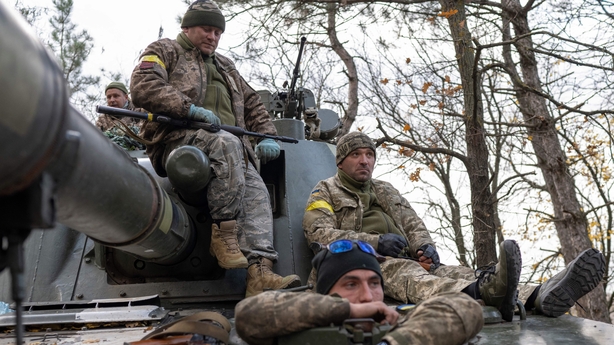
Natalia Humeniuk, spokesperson for Ukraine’s southern military command, said it could be a Russian trap.
“This could be a manifestation of a particular provocation, in order to create the impression that the settlements are abandoned, that it is safe to enter them, while they are preparing for street battles,” she said in televised comments.
“We continue fighting, also in the Kherson direction, despite the fact that the enemy is trying to convince us that they are leaving the settlements and creating the effect of a total evacuation,” she said.
Battlefield priority
Russia has fought for months to hang on to the pocket of land it holds on the west bank at the mouth of the river that bisects Ukraine. Moscow had sent tens of thousands of troops to reinforce the area, one of its biggest battlefield priorities.
Ukraine has targeted the main river crossings for months, making it difficult for Russia to supply its huge force on the west bank. Ukrainian troops have been advancing along the river since bursting through the Russian frontline there at the start of October, although their advance had slowed in recent days.
Russia had ordered civilians to evacuate from occupied areas on the west bank, and this week also ordered them out of a 15km buffer zone on the east bank as well. Kyiv says those evacuation orders amount to forced deportation, a war crime.
Mr Stremousov urged civilians remaining in Kherson city to leave immediately, saying they were putting their lives in danger.
Ukraine maintains tight secrecy about the progress of its troops at the front in Kherson but has so far been publicly cautious about any suggestions that Russia is vacating positions there. Ukrainian troops on the front line last week said they saw no evidence Russian forces were withdrawing and believed they were in fact reinforcing.
Michael Kofman, a top US expert on the Russian military who has just returned from the Ukrainian side of the Kherson front, said Moscow’s intentions were unclear. He doubted Russia would abandon the west bank of the river “without being forcibly pressed out”, but he also “could be wrong about this”.
“The situation in Kherson is clear as mud,” tweeted Mr Kofman, director of Russia studies at the Center for Naval Analyses think-tank.
“Russian forces seemed to withdraw from some parts, evacuated, and drew down, but also reinforced with mobilised personnel. The fighting there is difficult. Despite constrained supply, Russian forces do not appear to be out of ammo.”
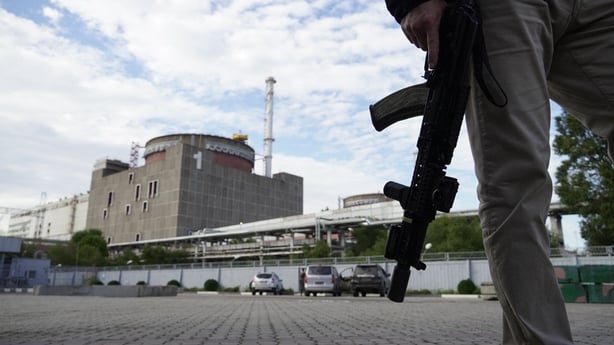
Nuclear plant disconnected from grid
Russian attacks have been reported across large areas of Ukraine, with heavy shelling in numerous regions damaging infrastructure, including power supplies to Europe’s largest nuclear power plant, Ukrainian officials have said.
The Zaporizhzhia nuclear power plant in southern Ukraine has again been disconnected from the power grid after Russian shelling damaged the remaining high voltage lines, leaving it with just diesel generators, Ukraine nuclear firm Energoatom said.
The plant, in Russian hands but operated by Ukrainian workers, has 15 days’ worth of fuel to run the generators, Energoatom said.
Russian strikes were also reported in Kriviy Rih, in central Ukraine, and in Sumy and Kharkiv, in the northeast. Heavy fighting was ongoing in the eastern regions of Luhansk and Donetsk.
“The enemy is trying to keep the temporarily captured territories, concentrating its efforts on restraining the actions of the Defence Forces in certain areas,” Ukraine’s general staff said this morning.
Russia has said it targeted infrastructure as part of what it calls its “special military operation” to degrade the Ukrainian military and remove what it says is a potential threat against Russia’s security.
As a result, Ukrainian civilians have endured power cuts and reduced water supplies in recent weeks. Russia denies targeting civilians, though the conflict has killed thousands, displaced millions and left some Ukrainian cities in ruins.
Grain deal resumes
The attacks come after Russia said it would resume its participation in a deal freeing up grain exports from Ukraine, reversing a decision that world leaders warned would increase hunger globally.
Russia, whose forces invaded Ukraine on 24 February, announced the reversal yesterday after Turkey and the United Nations helped keep Ukrainian grain flowing for several days without a Russian role in inspections.
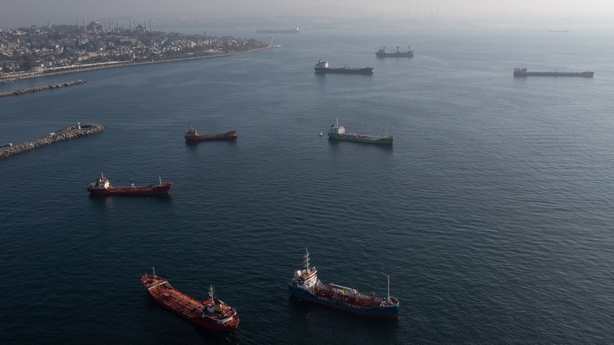
The defence ministry justified the resumption by saying it had received guarantees from Ukraine that it would not use the Black Sea grain corridor for military operations against Russia.
“The Russian Federation considers that the guarantees received at the moment appear sufficient, and resumes the implementation of the agreement,” the ministry said in a statement.
Ukrainian President Volodymyr Zelensky said it was important to stand up to “crazy Russian aggression that destabilises international trade”.
“After eight months of Russia’s so-called special operation, the Kremlin is demanding security guarantees from Ukraine,” Mr Zelensky said in his nightly video address.
“This is truly a remarkable statement. It shows just what a failure the Russian aggression has been and just how strong we all are when we maintain our unity.”
The grain deal, originally reached three months ago, had helped alleviate a global food crisis by lifting a de facto Russian blockade on Ukraine, one of the world’s biggest grain suppliers.

The prospect of it collapsing this week revived fears of a worsening food crisis and rising prices.
The prices of wheat, soybeans, corn and rapeseed fell sharply on global markets after Russia’s announcement.
Mr Zelensky credited Turkey and the United Nations for making it possible for ships to continue moving out of Ukrainian ports with cargoes after Russia suspended participation on Saturday.
Russia suspended its involvement in the deal saying it could not guarantee safety for civilian ships crossing the Black Sea after an attack on its fleet.
Ukraine and Western countries called that a false pretext for “blackmail”, using threats to the global food supply.
Russian official signals new retreat in south Ukraine
Source: Viral Trends Report


0 Comments