

China’s western Xinjiang region has eased some Covid-19 restrictions in its capital Urumqi, after a deadly fire in the city blamed on virus controls sparked protests across the country.
People in the city of four million, some of whom have been confined to their homes for weeks on end, can travel around on buses to run errands within their home districts starting tomorrow, officials said at a press conference today.
Certain essential businesses in “low-risk” areas could also apply to restart operations – at 50% capacity – while public transport and flights will start “resuming in an orderly manner”, officials said a day earlier.
Ten people were killed when a blaze ripped through a residential building in Urumqi on Thursday night, spurring crowds to take to the streets in multiple Chinese cities this weekend to protest against the country’s strict zero-Covid policy.
We need your consent to load this rte-player contentWe use rte-player to manage extra content that can set cookies on your device and collect data about your activity. Please review their details and accept them to load the content.Manage Preferences
Many social media users blamed Covid lockdowns in Urumqi for hampering rescue efforts, but officials have instead said private cars obstructed firefighters.
Chinese foreign ministry spokesman Zhao Lijian lashed out at “forces with ulterior motives” for linking the fire with Covid.
But in the wake of the protests, officials said the city “had basically reduced social transmissions to zero” and they would “restore the normal order of life for residents in low-risk areas in a staged and orderly manner”.
Officials at the press conference today said Urumqi would also resume parcel delivery services – but logistics workers would have to stay in a “closed loop” at company dormitories.
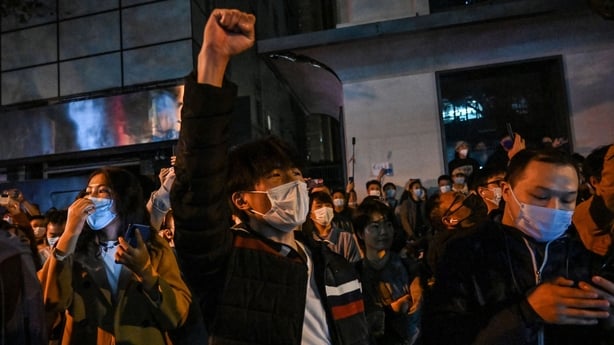
China’s unrelenting zero-Covid push has sparked protests and hit productivity in the world’s second-largest economy, as the public grows weary of snap lockdowns, lengthy quarantines and mass testing campaigns.
A series of new rules announced by Beijing earlier this month appeared to signal a shift away from the strategy, easing quarantine requirements for entering the country and simplifying a system for designating high-risk areas.
But officials have instead dug in their heels, even shutting down large parts of China’s capital as national case numbers shot past the 30,000 mark in recent days to record highs.
Public anger boiled over on the weekend when hundreds gathered on university campuses and cities around the country demanding an end to the zero-Covid policy.
Chinese police have reportedly detained three people at a protest site in Shanghai.
When asked why one of the people was taken away, a policeman told AFP “Because he didn’t obey our arrangements” and then referred the reporter to police.
Police were also pulling people aside and ordering them to delete photos from their phones.
Large crowds had gathered yesterday in the downtown area, with police clashing with protesters as they tried to stop groups from converging at Wulumuqi street.
AFP journalists saw several people detained last night, and multiple witnesses saw people taken away in earlier protests.
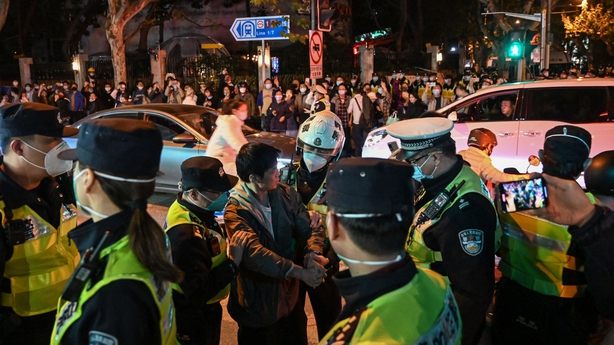
In Shanghai, demonstrators and police clashed yesterday, with police taking away a busload of protesters.
China’s foreign ministry said the journalist, Ed Lawrence, had not identified himself.
“Based on what we learned from relevant Shanghai authorities, he did not identify himself as a journalist and didn’t voluntarily present his press credentials,” foreign ministry spokesperson Zhao Lijian said.
Meanwhile, a spokesman for British Prime Minister Rishi Sunak has said that the detention of Mr Lawrence was “shocking and unacceptable”.
Britain will raise concerns with China about the response to protests while the government will continue to seek constructive relations with the country on other issues, the spokesman said.
“We will continue to raise our human rights concerns with the Chinese government at all levels as part of a frank and constructive relationship,” he said.
“The arrest of this journalist, who was simply going about their work, is shocking and unacceptable. Journalists must be able to do their jobs without fear of intimidation.”
China posted another record number of Covid-19 infections today, in scenes unprecedented since President Xi Jinping assumed power a decade ago.
China’s Xinjiang eases some Covid curbs after protests
Source: Viral Trends Report





0 Comments