

President Volodymyr Zelensky warned Ukrainians to expect another brutal week of cold and darkness ahead, predicting more Russian attacks on infrastructure that would not cease until Moscow ran out of missiles.
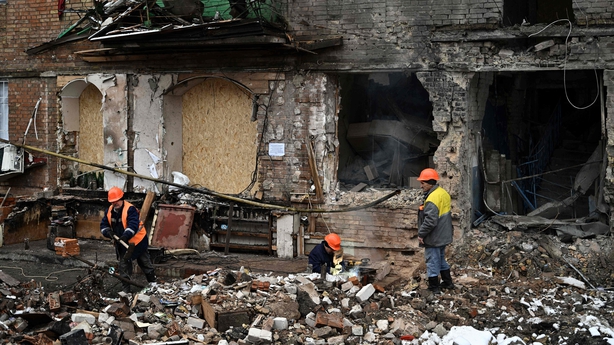
Russia has been carrying out massive missile bombardments on Ukraine’s energy infrastructure almost weekly since early October, with each barrage having greater impact than the last as damage accumulates and a cold winter sets in.
In an overnight address, Mr Zelensky said he expected new attacks this week that could be as bad as last week’s – the worst yet – that left millions of people with no heat, water or power.
“We understand that the terrorists are planning new strikes. We know this for a fact,” Mr Zelensky said in his nightly video address. “And as long as they have missiles, they, unfortunately, will not calm down.”
Kyiv says the attacks, which Russia acknowledges target Ukrainian infrastructure, are intended to harm civilians, making them a war crime.
Moscow denies its intent is to hurt civilians but said last week their suffering would not end unless Ukraine yielded to Russia’s demands, without spelling them out.
In Kyiv, snow fell and temperatures were hovering around freezing as millions in and around the Ukrainian capital struggled with disruptions to electricity supply and central heating caused by the waves of Russian air strikes.
We need your consent to load this rte-player contentWe use rte-player to manage extra content that can set cookies on your device and collect data about your activity. Please review their details and accept them to load the content.Manage Preferences
National grid operator Ukrenergo said today it had been forced to resume regular emergency blackouts in areas across the country after a setback in its race to repair energy infrastructure.
Power units at several power stations had to conduct emergency shutdowns and demand for electricity has been rising as snowy winter weather has set in, a Ukrenergo statement said.
“Once the causes of the emergency shutdowns are eliminated, the units will return to operation, which will reduce the deficit in the power system and reduce the amount of restrictions for consumers,” it said.
Along front lines in the east of Ukraine, the looming winter is ushering in a new phase of the conflict with intense trench warfare along heavily fortified positions after several months of Russian retreats.
With Russian forces having pulled back in the northeast and withdrawn across the Dnipro River in the south, the front line on land is only around half the length it was a few months ago, making it harder for Ukrainian forces to pinpoint weakly defended stretches to mount a new breakthrough.
Zelensky described heavy fighting along part of the front west of the Russian-held eastern city of Donetsk where Moscow has focused its assault even as it has withdrawn troops elsewhere, and both sides claim huge casualties with little change in positions.
In its evening update today, Ukraine’s armed forces General Staff said Russia kept up heavy shelling of key targets Bakhmut and Avdiivka in Donetsk province, and to the north bombarded Kupiansk and Lyman, both recaptured recently by Kyiv.
On the southern front, it said, Russian forces had reinforced positions in occupied territory and were heavily shelling towns on the west bank of the Dnipro River, including Kherson, abandoned by Moscow earlier this month.
It said Ukrainian forces had damaged a rail bridge north of the Russian-occupied southern city of Melitopol that has been key to supplying Russian forces dug in there.
Reuters could not independently verify battlefield reports.
Ukraine has gained an advantage on the battlefield in part from deploying Western rocket systems that allow it to target Russian positions behind front lines, partly neutralising Moscow’s big edge in artillery firepower.
The Kremlin denied Russia had any plans to withdraw from the Zaporizhzhia nuclear power plant, Europe’s largest, which it has controlled since early in the war near the front line on a reservoir on the Dnipro.
The head of Ukraine’s nuclear power operator, Petro Kotkin, had said yesterday there were signs Russia might pull out. But Kremlin spokesman Dmitry Peskov responded today: “There’s no need to look for signs where there are none and cannot be any.”
Russia says it has annexed the area and put the plant under the control of its nuclear power agency.
The UN nuclear watchdog, the IAEA, has called for the plant and surrounding area to be demilitarised to prevent a nuclear disaster.
In Kherson, a southern city that has been without power or heat since Russian forces abandoned it earlier this month, regional governor Yaroslav Yanushevych said 17% of customers now had electricity. Other districts would be hooked up soon.
Russian forces who withdrew have been bombarding from across the river, killing dozens of civilians.
Russia won’t halt ‘until it runs out of missiles’
Source: Viral Trends Report





0 Comments